Episode Transcript
[00:00:04] Good morning, folks.
[00:00:07] Ade brought a bit of a prophetic word earlier on in the service. He said he thought that there were people here going through some hard stuff, and there's a promise that God has a plan and a purpose and a will for you, whatever you're going through. Well, my sermon today is biblical evidence that that promise is true.
[00:00:27] Ada and I hadn't discussed what I was going to say, and, in fact, I'd written a different sermon. I'd written a sermon about baby dedication, but I felt that God wanted me to bring this word. After I spoke to somebody a little while ago, and I was just listening to their view of their life, and it was pretty bleak. And whatever they were going through, from my perspective, seemed to be okay, but from their perspective, everything seemed to be bleak. History, present, future, all of it was bleak. And I thought about the character in the Bible that I want to speak to you about today.
[00:01:06] And then we sang that song, which is one of my favorite hymns, if not my favourite hymn. It has that line in it. When Satan tempts me to despair, Satan will tempt us to develop a bleak view on life and to despair, whatever our circumstances. One thing I've discovered in life is that no matter whether I had a difficult background or not, there's always people that had a more difficult background. Whatever my current situation is, there are people that have a more difficult, complicated, and bleak situation today.
[00:01:42] But whenever I look forward, forward through the lens of the love of God, then all of us have a blessed and glorious and powerful future. Do you know that? Some people will be in their despair and their bleakness, and they won't know it? So today I want to talk to you about a character that's in the Old Testament, a character called Hagar. Not Hagar the horrible, but Hagar the wonderful.
[00:02:12] So you'll find the story of how Hagar finds grace in her desert in Genesis 16 114.
[00:02:22] The central character in our story, and the way that I'm going to speak about it, is Hagar. She's a slave girl. Her owners are Seirei and Abram. And at the end of the story, Ishmael, or towards the end of it. And Isaac puts in a very brief appearance, too, in the story. Everybody, all of the characters, everybody has disappointment and discouragement at some part of their story, and yet God is central. The presence of God is powerfully present throughout the whole story, and I'm going to read it to you in two parts in a little moment.
[00:03:03] I want to set the context. First, Abraham. When we first meet him in Genesis 1126 is living in a city called ur of the Chaldees. If you love people and history, then you will recognise how important it is that he lived in a city, because we're talking about Bronze Age people with very little technology, very little stuff going on. So why would they live in a city? Well, a city could be defended. You know, there's a scripture that says, the name of the Lord is a strong tower. The righteous run to it and are saved. That is the beginnings of a city. Physically, we know it spiritually, but physically, there would be a strong tower. Now, I just moved here last year from Benfleet, and in Benfleet was a viking battle between troops of Alfred the great and troops of the viking invaders. And St Mary's Church in Benfleet was burned to the ground by the viking invaders. If you go to most old villages in England, you'll find that there's quite often a strong norman castle, castellated on top, so it looks like a castle sometimes, with arrow slits and all kinds of stuff going on. And you think, what's all that about? Well, it's because of that scripture, and it's because the beginnings of a fortification or defense would be to build a tower that the people in the area could run to form an army and defend themselves against marauders. So the name of the lord is literally a strong tower, and the righteous run to it and are saved. That's an interesting illustration, isn't it? Just a bit of interest? Not much to do with Hagar, but there it is. I like throwing these things in dry sermons for flavour. So he's living in ur of the Chaldees. It's a city and people can develop a standing army and they can defend themselves against marauding invaders. If you want to understand that a bit more, look at the story of Gideon, where Gideon is hiding in a wine press, because all the tribes that live around Israel have sent marauding invaders with camels. And the newest technology they had was a camel saddle. I'm on another rabbit run now.
[00:05:20] They developed the camel saddle. Why is that important? That's because the Israelites were used to fighting people on foot, so they had swords and perhaps shields. If you're an infantryman with a sword and a cavalry attacks, let me tell you, you're in trouble. So when they rode in on their camel saddles, their little short swords couldn't reach the bloke on top of the camel, so they had lances, long spears, and they could reach everybody and poke them with their spears from the back of the camel. Then they had big saddlebags. So when in the Gideon, you read that they took all of their produce, that's because they could fill their saddlebags and use their camels as a beast of burden so they could strip everything out of Israel. That's why Gideon was hiding in a little rut of his own making. But here we are. That's urtainden. So God speaks to abram in Ur and says, listen, I want you to leave this place, and I want you to go to a place that I'm promising you. It's called Canaan. So now he's leaving AlL of the security of the standing army of the City, which has become a geographical center where there's lots of water and food and all kinds of stuff coming into that place because it's stable and it's always there. And God says, I want you to leave the security, all of this, and follow my promises into the desert, into Canaan. That's a pretty powerful thing to do.
[00:06:47] So he leaves there with his wife and family, and he goes down. And here, where we pick up the StoRy, he's in CANaan. God had promised him that he would HAve ChIldREN, he would have nations that would come forth from him. And now he's living in Canaan, but the land isn't his. These surrounded by hostile elements and hostile people. So the promise of God, he's fulfilled his part, hasn't he? He's left his security and by faith, he's gone into Canaan, and he's now in the promised land. And he's thinking to himself, where are my children?
[00:07:23] Where is the land? Why doesn't the land belong to me? That's what God promised me. You know, sometimes people pursue God into a promise that they believe God has given them. And his perspective on time is different from ours. So we can be as obedient in faith as you like, but we can get to where we think we're supposed to be. And we think, where are you, God?
[00:07:50] Why aren't your promises being fulfilled in my life? You see, here is Abraham and Sarah living in disappointment.
[00:07:58] They believe theyve done everything that God called them to do, but hes cracking on a bit. He was 75 when God said he could have children. Now, if I was in his sandals, I would expect to have a bit of a family going on, but hes got nothing. And even the land and the people in it are still hostile to him.
[00:08:18] Can you imagine his disappointment?
[00:08:23] Some people think it was Shakespeare, but actually it was proverbs. It says, hope deferred makes the heart. But a longing fulfilled is a tree of life.
[00:08:31] And Abraham and Sarah are living with deferred hope. Because the promise hasn't been fulfilled in their lifetime.
[00:08:39] So their hearts are sick.
[00:08:41] That's why they made very poor decisions in the beginning of this story. That's why they made this decision. That said, we need to do something extra to make the promise of God be fulfilled. And it's a warning, isn't it, to us to live in faith and obedience. And not try and create our own solutions to God's promises?
[00:09:07] Is anybody here living for an unfulfilled, long term promise? I've been a church leader and a youth leader before that for long enough to know that there are lots of people. They won't necessarily tell you because they feel as if they shouldn't. They feel as if theyre letting God down. If they admit that theyre disappointed. Because they are waiting for God way beyond what they thought it would be. And their patience, their spiritual patience is wearing thin.
[00:09:37] Of course, its not only God that makes promises that can be unfulfilled. Sometimes it can be parents who tell you you can do anything. You could do anything with your life. The world is your oyster. No, it's not.
[00:09:51] No, it's not. I can't sing and tap dance. And I'm 68 and I never could. And my mum wanted me to, mind you. She wanted me to join the navy. And I went up and joined the Royal Marines. But this inner conflict for Abraham and Sere, this is a major factor in their relationship with one another. But also in their relationship with God. That's the context. Now let's read the story together.
[00:10:20] Can we have the first scripture up, please?
[00:10:23] Okay. Now, Sarah Abrams wife had borne him no children. But she had an egyptian slave named Hagar. So she said to Abram, the Lord has kept me from having children. Go sleep with my slave. Perhaps I can build a family through her.
[00:10:39] Abraham agreed to what era said. So. After Abram had been living in Canaan for ten years. Zerei, his wife, took her egyptian slave hagar. And gave her to her husband to be his wife. He slept with Hagar and she conceived. When she knew she was pregnant, she began to despise her mistress. Then Sarai said to Abraham, you are responsible for the wrong that I am suffering.
[00:11:06] I put my slave in your arms. And now that she knows shes pregnant, she despises me. May the lord judge between you and me.
[00:11:16] Your slave is in your hands. Abraham said, do with her whatever you think best. Then Sarai mistreated Hagar so that she fled from her the angel of the Lord. Does anybody know who that is? When the Bible says the angel of the Lord, do we know who that is?
[00:11:35] It's called a Theophany. It's Jesus, the angel of the Lord. When the Bible talks about the angel of the Lord, even in the Old Testament, we're looking at Jesus also. The guy that met Gideon was the captain of the army of the Lord. It's called a Theophany. It's Jesus in pre incarnate form. Is that interesting? That means this conversation is very important because it's Jesus coming to talk.
[00:12:02] So the angel of the Lord found Hagar near a spring in the desert. It was the spring that is beside the road to Shur. And he said, hagar, slave of Sere, where have you come from and where are you going? I'm running away from my mistress Seirei. She answered. Then the angel of the Lord told her, go back to your mistress and submit to her. The angel added, I will increase your descendants so much that they will be too numerous to count. The angel of the Lord also said to her, you are now pregnant and you will give birth to a son. You shall name him Ishmael. For the Lord has heard of your misery. He will be a wild donkey of a man. His hand will be against everyone and everyones hand against him. And he will live in hostility towards all his brothers.
[00:12:49] She gave this name to the Lord who spoke to her. You are the God who sees me. For she said, I have now seen the one who sees me. That's why the well was called bir lahi ra, because it's still there between Kadesh and Bereb. So Hagar bore Abram a son, and Abram gave the name Ishmael to the son she had born. Abram was 86 years old when Hagar bore him Ishmael. Let's pray, father, when we read your word until you add your spirit, it's just an interesting story. It's just words in a book. But when you add your spirit, your word becomes living and active. And we pray that we receive that active, living word in our hearts today, especially those who are in despair. In Jesus name, amen.
[00:13:41] So if you look at the three main characters, we see sare, strong willed, but seemingly angry, disappointed, bitter.
[00:13:51] Her experience includes significant deception, and she is often curt and even unforgiving in her dealings with people.
[00:14:01] Abram, a hero of the faith in Hebrews, is presented here as weak. He's not very good at marriage. He's not very good generally with women, and he certainly seems to be living in fear of his wife. I won't ask how many people might be identifying with that one. He's a complex character, courageous in faith. He left ur of the Chaldees and followed God's promise into the desert. But he's willing to compromise moral responsibility to the bidding of Seirei. He's not exactly a coward, but he's lacking courage and integrity.
[00:14:39] And then the third central character is Hagar. She's a gentile, an egyptian slave of whom much is demanded, including the use of her womb, which I think is quite amazing.
[00:14:57] Was this against her will, where she was a slave? So it didn't really matter. She probably wasn't asked or even allowed to have her own opinion. I wonder how she felt, this young egyptian woman being partnered with this 85 year old man who was understandably quite keen on the relationship.
[00:15:18] Ishmael makes his appearance right at the end of the story and most of his story takes place in the future. But Ishmael is very important, as we'll see. It's easy to write him off as a bit of a villain. His character is described in that scripture prophetically, like by God as a donkey in the wilderness. It's not very attractive, is it? But Ishmael is important, especially to Islam, but also in Christianity.
[00:15:46] But the central character is Hagar. So I do want to spend some time looking at her.
[00:15:53] My first point is called God made Hagar in her deepest need, but it's worth examining just what her deepest need looked like. Otherwise we might not be able to make our own personal connection with her in this story.
[00:16:08] But there is a lot of connection with us.
[00:16:12] And God met Hagar as he meets very few people through the ages.
[00:16:18] Like many of us, God met her in her distress and he spoke to her and he provided a way and a hope and so much more. The story of Hagar has inspired lots of famous people through the ages and she is included in many authors stories such as William Shakespeare, Daniel Defoe, Samuel Taylor Coleridge, Nathaniel Parker Willis, even Salman Rushdie and Margaret Atwood have all featured Hagar in their writings.
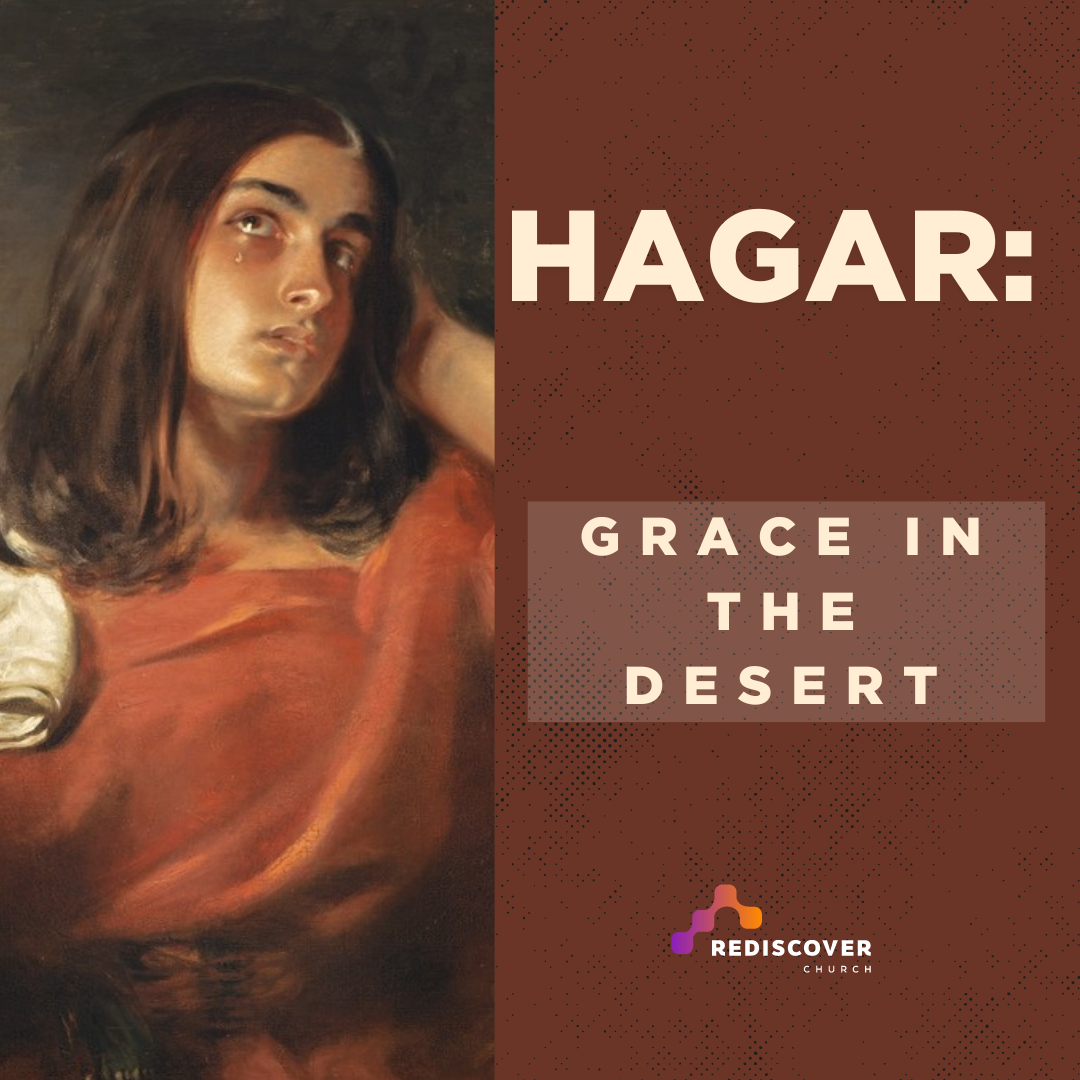
[00:16:48] So have many artists. But I like this picture that I've chosen here. I don't know if you can see it from the back. This has been painted by Andrew Geddes and it's kept in the art gallery in Glasgow. And I think he seems to have captured her sadness. There's one single tear tracking down her face.
[00:17:08] The spotlight on Hagar begins when Abram and Sere doubt that God is either going to or is able to fulfill that incredible promise that they would have a son. Tired of waiting, Sere tries to hurry the process by arranging a surrogate.
[00:17:26] Now, this might seem offensive today, but actually this form of surrogacy through a slave was quite acceptable to the culture of the ancient near east. Acceptable to Sereihdev, the desperate slave owner. Acceptable to the weak willed Abraham. He was going to get a young concubine to sleep with as an alternative to the bitterness of Sere, which I don't suppose is very attractive to him at all at this point.
[00:17:53] But we don't know what Hagar, the slave girl, thought about it all.
[00:17:58] Sere. Her troubling plan led to even more sorrow, distress, and pain. But that's what Hagar Seirei's maidservant got, too.
[00:18:10] She didn't choose a life of suffering. Genesis 16 one six. She didn't choose to be a concubine to an old man. She didn't choose to have a son. Ishmael. Genesis 16 and 25 talks to that. And she certainly didn't choose to be a picture of God's law given through Moses, which is how Paul describes her in Galatians 424 25.
[00:18:36] She now represents every woman and man, for that matter, who lives a claustrophobic life deprived of freedom. By that I mean deprived of the ability to choose anything in life, location, direction, education, financial freedom, even sexual freedom. Hagar is so much more to us than that.
[00:19:01] Amazingly, through grace in the desert, she comes to know God intimately. Genesis 16 714. And in fact, she's the first human being to give him a new name, which is so powerfully moving, I think, especially if you're facing bleak outlooks, the new name is the Lord who sees me in these ways and more. Hagar is a hero of faith.
[00:19:28] There are many freedoms in the modern world that were not available to women even a generation ago, and freedom to choose can make us all isolated by the choices we make. Yet Hagar teaches us that our life is more about more than just us, even those things that we hope for and claim as promises.
[00:19:51] Hagar was hurt and hurting.
[00:19:54] We're not told how she became a slave, but slave she was property of someone else. A slave, by definition, has no freedom. Yet she received grace in the desert. Being made pregnant seemed for a while to change her social standing, but it never changed her legal standing. She was always a slave as the surrogate mother of Abraham's child, and having been accorded the title of wife in verse three. She expected to be somehow raised up and she became haughty. It's a great word, haughty, isn't it? It's an old fashioned word. I wonder how many of you have used that word haughty recently. But I can imagine what haughty means, can't you? Stiff neck, looking down your nose at people. She became haughty looking down on Sere.
[00:20:47] Perhaps in egyptian culture a surrogate mother would have a different future. Perhaps she thought that it was a way towards freedom. Perhaps Abraham had made promises. That is, of course, speculation because the Bible doesn't tell us. But we do not see Hagar as a villain of the peace. That's much too easy for us. Rather than raising her status she became humiliated, abused and rejected by sere. So much so that she risked her life by running away. I wonder where she thought she was going. I wonder if she thought she was crossing the desert to Egypt to what she thought of as freedom to her family. Maybe to her mother. Maybe she was worried that her child was in danger, being rejected by Sarai. Perhaps the child would grow up being a slave with no freedom. Maybe in Egypt the child would be free.
[00:21:45] Now, in the Bible, generally speaking, Egypt represents the world bad and Israel represents the kingdom good.
[00:21:53] Generally. You can break that down and prove me wrong in some respects. But generally speaking, that's the way it is. So it's interesting that this gentile woman effectively wants to run to the world. I remember talking to a plumber friend of mine one time who had backslidden left the church and he said to me, Dave, I'll find more freedom in the world than I ever did in church because of the expectations that people put on me. I can't tell you how tragic that is.
[00:22:25] Absolutely tragic that people don't find grace in a church but think they find freedom in the world. Hagar was heading for Egypt. Yet in her bruised heart, she experienced the grace of God. She realized that he had never rejected her. Being seen by God in her desert of shame, bitterness, unfairness meant acceptance, love and even restoration.
[00:22:52] Knowing that she'd been seen by God as she prayed and cried out to him changed her life. She knew beyond a shadow of a doubt that God saw her and loved her.
[00:23:04] The message of the angel shows that God knew her.
[00:23:08] Her situation was not a surprise to God and he showed her five truths that demonstrated that he had always seen her and always loved her. First, he saw her faults.
[00:23:21] Perhaps unsurprisingly, she had bitterness in her heart. Towards Serre, and it seeped out through her haughty looks and words. Second, he saw Hagar's frustrations that she chafed at her slavery, at being powerless and with being abused. Third, he saw her fear, her terrible fear. This was a fear that caused her to risk her life and the life of her unborn child. Her fear drove her to run away. Fourth, God saw Hagar's family. He told her that she would have a son who would father a great nation.
[00:23:56] Finally, he saw her future.
[00:24:00] And in telling her that her son had a future, he gave her a sense of purpose, destiny and security.
[00:24:08] There was to be honour in her godly legacy.
[00:24:13] Then he asked her to do some different difficult things. First, to bear a child. Second, to be part of a bad plan, Sarah's plan. But he would turn it into great blessings. Third, to return to an emotionally abusive situation. Fourth, to experience rejection and finally, to trust him for a brighter future.
[00:24:34] Sometimes it seems that God asks us to endure a lot of difficulties. This is hard, but godly answers are not always easy. Now, I'm not at all for 1 second advocating that people remain in a violent or abusive relationship or a violent or abusive situation, nor evenly an emotionally or sexually abusive relationship. I think it's better that people suffer like that. Get out.
[00:25:02] But I am advocating being sure that you find God's solution to your difficulties. That may mean leaving an abusive relationship, even marriage, but it does not involve running to the world or anywhere outside of the kingdom of God for your security and your solutions, because that won't be what you find. I the bad plan had been seres. The only solution that appeared to a distressed hagar was to escape, run into the desert and risk life. But this was no solution at all. God gave her a way that would give her and her baby life and promise and fulfilment. And although she may not have seen it at that moment, she would ultimately prosper.
[00:25:49] It may be that you feel stuck with no prospects at all. But in her deepest, darkest moment, Hagar discovers that God saw her. Not only that he saw her, but that he had a righteous love for her. A lady that was not used to righteous love at all found righteous love in God. God sees you. He has a righteous love for you. He has a plan for you. Seek him in your desert at the well. The well is here at Rediscover, Newton Abbott. It's in churches all over the land that are spirit filled. And Jesus describes himself as the living water that will bring you life through the ministry of the Holy Spirit.
[00:26:34] So the second part of Hagar's story, 18 years or so later, so Ishmael's born and is growing up. Abram and Sarai were now Abraham and Sarah. It seems that Hagar and Ishmael had experienced 18 years of slavery to Sarah. I don't suppose that any of it was easy. Ishmael had grown and Abraham loved him. But when he was about 15, Isaac was born. And three years later, we come to the second part of the story. Genesis 21 821, we read the child, that's Isaac, grew and was weaned. And on the day Isaac was weaned, which would have been about three years old in jewish culture, Abraham held a great feast. But Sarah saw that the son whom Hagar the Egyptian had borne to Abraham was mocking. And she said to Abraham, get rid of that slave woman and her son. For that woman's son will never share in the inheritance with my son Isaac.
[00:27:37] The matter distressed Abraham greatly because it concerned his son. But God said to him, do not be so distressed about the boy and your slave woman. Listen to whatever Sarah tells you because it is through Isaac that your offspring will be reckoned. I will make the son of the slave into a nation also because he is your offspring.
[00:27:56] Early the next morning, Abraham took some food and a skin of water and gave them to Hagar. He set them on her shoulders and sent her off with the boy. She went on her way and wandered in the desert of Beersheba. When the water in the skin was gone, she put the boy under one of the bushes. Then she went off and sat down about a bow shot away, for she thought, I cannot watch the boy die. And as she sat there, she began to sob.
[00:28:23] God heard the boy crying. And the angel of God called to Hagar from heaven and said to her, what's the matter, Hagar? Do not be afraid. God has heard the boy crying as he lies there. Lift the boy up and take him by the hand, for I will make him into a great nation.
[00:28:41] Then God opened her eyes and she saw a well of water. So she went and filled the skin with water and gave the boy a drink. God was with the boy as he grew up. He lived in the desert and became an archer. While he was living in the desert of Paran, his mother got a wife for him from Egypt.
[00:29:00] Seirei seems to have been unable to forgive Hagar. And now she saw the threat that Ishmael Washington to her child of promise. Isaac. Her protective mother's heart and probably her jealous heart produced her speaking to Abraham. But it's not nice, is it? Do something about that woman and her son. You'd think by now she knew her name, didn't you?
[00:29:25] When a woman calls somebody else that woman, you know there's trouble in the talk.
[00:29:31] Abraham was distressed. He was not an unkind man, but he was weak. He clearly loved Ishmael. God reassured him that he was to listen to Sarah and do what she requested.
[00:29:48] How many women would like that to be repeated over their husbands anyway? In obedience to God, Abraham sent Hagar and Ishmael away. Although covered in rejection this was also a release for Hagar from her slavery to Serei and surrogate marriage to Abram. So she wandered and soon found herself lost in the wilderness. Back in the desert, Hagar's water ran out beyond. Exhausted, fiercely thirsty and utterly hopeless. She wept.
[00:30:22] She thought, she and Ishmael. We're going to die.
[00:30:28] But God. That's a great expression, but God.
[00:30:32] But God gets involved when we think something's going wrong. But God gets involved. This is so important.
[00:30:41] God met Hagar again.
[00:30:44] Once more, God spoke to her. Remember how Abraham and Sarah got to this place? And the promises of God didn't seem to be fulfilled. They were living in Canaan, but the land wasn't there. They'd been promised children, but they didn't have any. I think Hagar, when she went back, she would have expected her circumstances to change. But instead, for 18 years she and her son endured slavery, abuse and contempt, really, from Sarah.
[00:31:13] But God. Once more, God spoke to her. He provided a way and a hope and so much more. He confirmed his grace and even provided the well.
[00:31:23] Why do I keep calling it grace?
[00:31:26] Because I don't think Hagar has any evidence that she did anything to deserve what God was doing.
[00:31:33] She was still stuck in a very difficult life. A life that could be described as a desert. A life without freedom. A life without anything at all.
[00:31:44] But God pours out his blessing. That's what grace is. You can't deserve grace. God gives it to you freely. And here he gives, because of his great love and mercy grace to Hagar.
[00:32:01] And their future was secure.
[00:32:04] I think it's also interesting as well that Ishmael got to have an egyptian wife and it was his mother that provided that for her.
[00:32:15] No matter how our hearts grow tender towards Hagar and stiffen towards Sarah this is not about the good girl and the bad girl. Both are fallible, yet both are loved by God. He speaks tender words to Hagar and rebukes Sarah. Yet he blesses Sarah as the mother of the promised one. She certainly doesn't deserve that.
[00:32:40] But God gives grace to Sarah, the mother of the faithful.
[00:32:45] Hagar, then, must portray slavery to the law. And that's how Paul describes her. As I said earlier on in Galatians, sometimes we feel as if we've been blessed once and that God won't do it again. And our lives can remain difficult and we can call out, but we just get this. Well, God blessed me once. Will he do it again?
[00:33:09] Heres an example. Hes blessed Hagar once, and now he meets her a second time, and he proves in that story to you that he sees you, that he hears your cry, and he knows every moment and minute of our lives, and he is always there. Not just sometimes, but even when life is difficult.
[00:33:36] This is true whether we sense God's deep love and care for us or not. Sometimes we feel it.
[00:33:43] But when life is tough, sometimes it seems impossible that God is there. But you know what? A child doesn't always feel loved by their mum and dad, but they are. Even when they're being disciplined. And in a much greater way, you are loved by God.
[00:34:01] So the Bible tells us that God not only created us and offers us his holiness, but he also sees us. Psalm 30 313 15. From heaven, the Lord looks down and sees all mankind.
[00:34:16] Not all mankind, except for me. Not all mankind, except for you, but all mankind. From his dwelling place, he watches all who live on earth, he who forms the hearts of all, who considers everything they do.
[00:34:31] God sees what happens to us. He sees our hearts, and he sees our response to what happens to us. But he longs to meet us in the desert.
[00:34:42] And I just love this new name that Hagar gave him. Genesis 1613. Hagar gave this name to the Lord who spoke to her. You are the God who sees me, for she said, I have now seen the one who sees me. That doesn't just mean a visual thing. That means a deep understanding in his heart. When you are seen by God, it goes beyond the physical. It's your character. It's your life. It's your hopes and your despairs. It's your great things and your difficult things. He sees you, and he knows you. Jehovah Roche is the God who sees. He sees everything.
[00:35:24] He sees you in your desert, and he loves you enough to provide you with living water and fellowship and prosperity and a future. Let's pray.
[00:35:38] Father, we are here today as people that if we didn't know it before, we've learned that even in the desert, you see us. You know us. You understand us that even when we expect to die, spiritually or physically, you provide living water and we can drink deeply and be restored.
[00:36:02] Lord, we don't have time, perhaps to pray for people this morning.
[00:36:06] But, Lord, I want people to know that your spirit is here.
[00:36:12] And it's one thing to be encouraged in a service.
[00:36:15] It's another thing to take that skin of living water into our lives and drink it.
[00:36:23] And whenever we need refreshment, to feed on your word and to drink of your spirit. And to know that, yeah, even if we have to endure, you're with us. And when it's time to be released from that disappointment, you will fulfill your promises in our lives. Even when we don't expect them, even when they pass their sell by date, you still intervene. And we thank you for it. Lord, help us to remember that promise. Remember that truth. Think about what Adi said at the beginning. About there are people here that are struggling and know that Hagar struggled in every area of her life. But you met her in the desert and you gave her all that she needed to flourish. Do it again, Lord. In Jesus name. Amen.